

Widespread flu activity overshadows holiday season
News you can use for the New Year
Respiratory Diseases
Regional editions will go out mid-week. Due to the holidays, most of the data I use for these reports has not been released yet. In the meantime, I’ve pulled together a brief update based on information from states that released data last week.
Influenza-like illness
Flu is spreading widely right now, with steep growth curves in many places. We’re seeing doubling and tripling of indicators (e.g., emergency department visits for influenza) from the prior week.
West
Colorado is in the thick of it: ED visits for flu are rising, accounting for 7.1% of all ED visits this past week, surpassing last year’s peak of 4.99%. Hospitalizations are also about to surpass last year’s peak. The hospitalization rate is now at 8.5 per 100,000 people. Last year, it peaked at 8.6. In Alaska, ED visits for influenza-like illness (ILI) are at 8.8%, which surpasses last year’s peak of 8.2%. And rates are still going up: lab-confirmed diagnoses of flu doubled between the week of December 13 and December 20.
It looks like we are nearing peak in Hawaii. Test positivity is leveling off around 28%. ED visits are at 9.4%, above last year’s peak of 7.8%. Hospitalizations for flu are elevated, but dipped slightly this past week, to 4.6% of all hospital admissions.
A few states are still at lower levels but are ramping up. In Arizona, ED visits for flu doubled in a week, from 1% to 2%, and confirmed flu cases also nearly doubled. Hospitalizations remain low, but are also increasing. In Nevada, outpatient visits for ILI1 are at 4.7% and rising.
Midwest
Flu activity is high in Minnesota. Flu activity more than doubled to 8.3% of ED visits and hospitalizations combined. The hospitalization rate has sharply increased to 9.0 hospitalizations per 100,000 people. In Illinois, flu activity is moderate and rising, with 4.5% of ED visits due to flu. Test positivity doubled this past week (to 20.5%), as did hospitalizations (to 2.3% of all admissions).
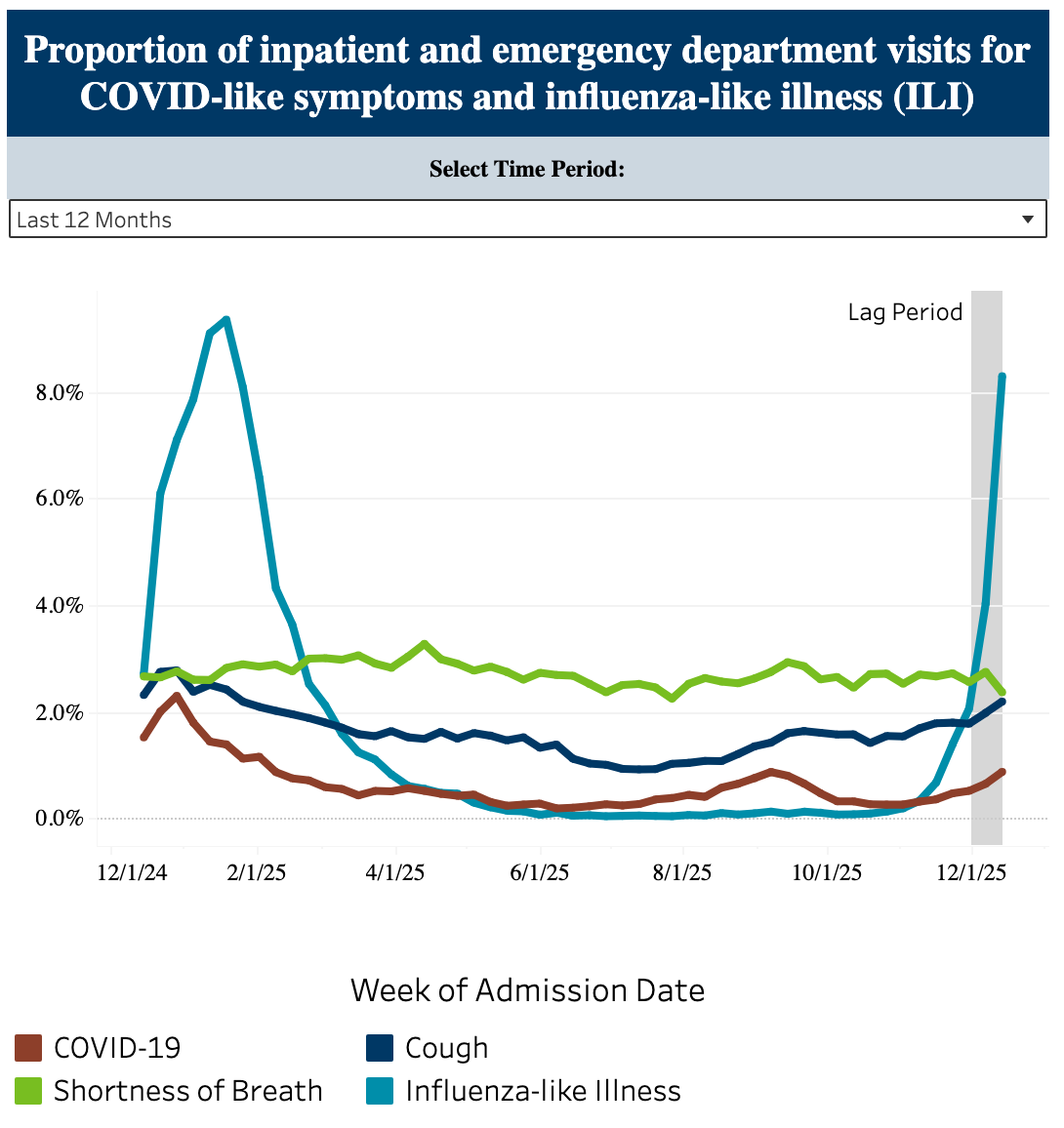
In Kansas, and Iowa rates are still a bit lower but are increasing rapidly. In Kansas, ED visits tripled this past week to 3.2% of all ED visits. And in Iowa, outpatient visits for ILI have increased sharply to 2.5%.
South
Influenza-like illness is high in Maryland, with ~6% of outpatient visits for ILI and nearly 1 in 3 samples testing positive for flu. A startling 43% of all outpatient ILI visits were children and young adults aged 5 to 24. In Alabama, ED visits for flu more than doubled this past week, to 6.3%. Tennessee is in similar territory, with 6.8% of ED visits due to flu.
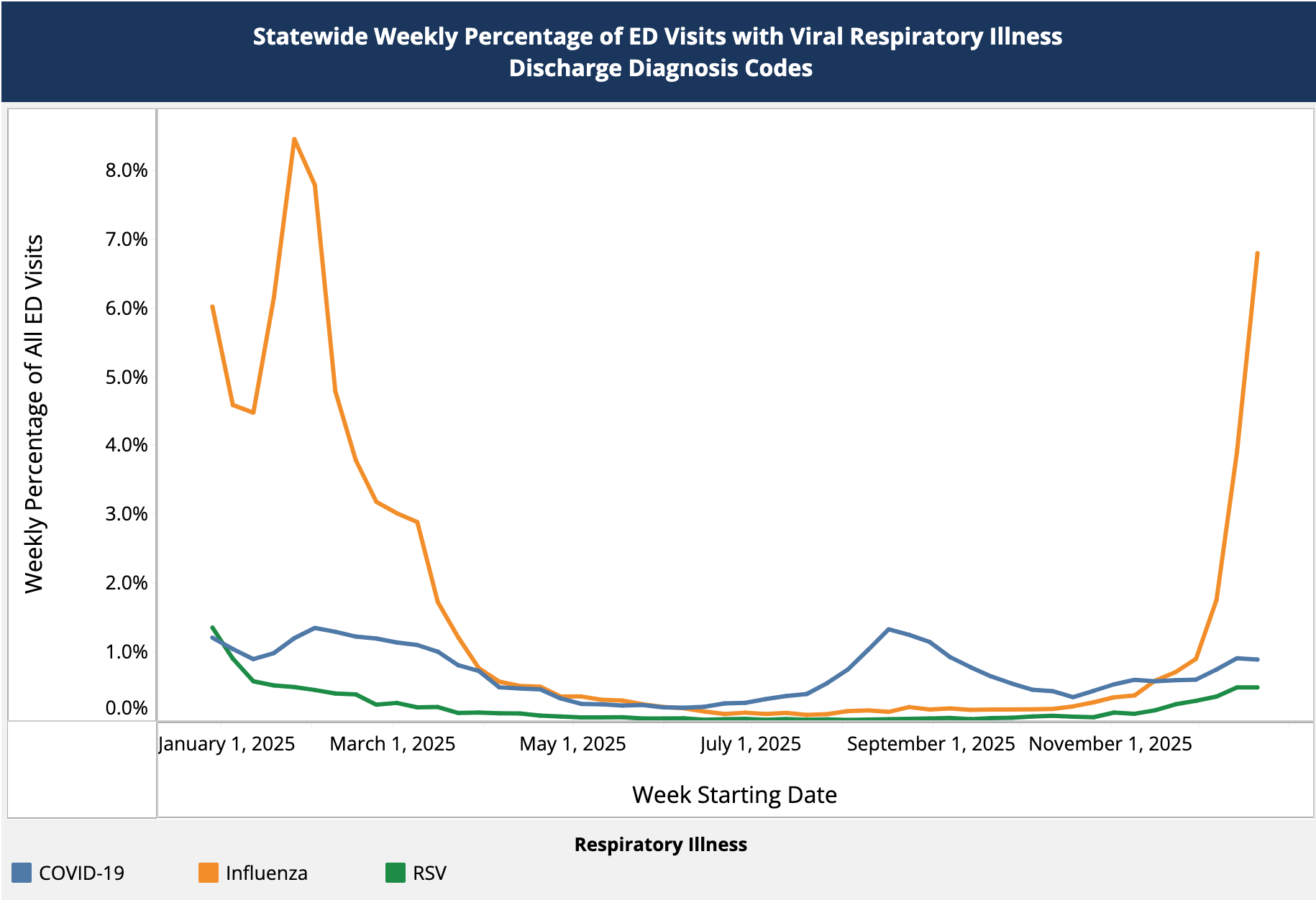
In Virginia and Kentucky, activity is still a bit lower, but is rising: visits to the ED roughly doubled this past week, to 4.9% and 4%, respectively.
Northeast
In Massachusetts, outpatient visits for ILI increased to 7.5%, and ED visits for flu increased to an estimated 6%. Hospitalizations are moderate and rising, doubling this past week to 4.8% of all hospitalizations.
In New Jersey, ED visits for flu ballooned from 0.8% to 8.0% over the a span of 3 weeks. One in three samples are coming back positive for flu. Outpatient visits for ILI are now at 11%, equivalent to last season’s peak, which did not occur until February. Severe illness is also rising rapidly, with hospitalizations doubling in the past week (to 1.6% of all hospitalizations).
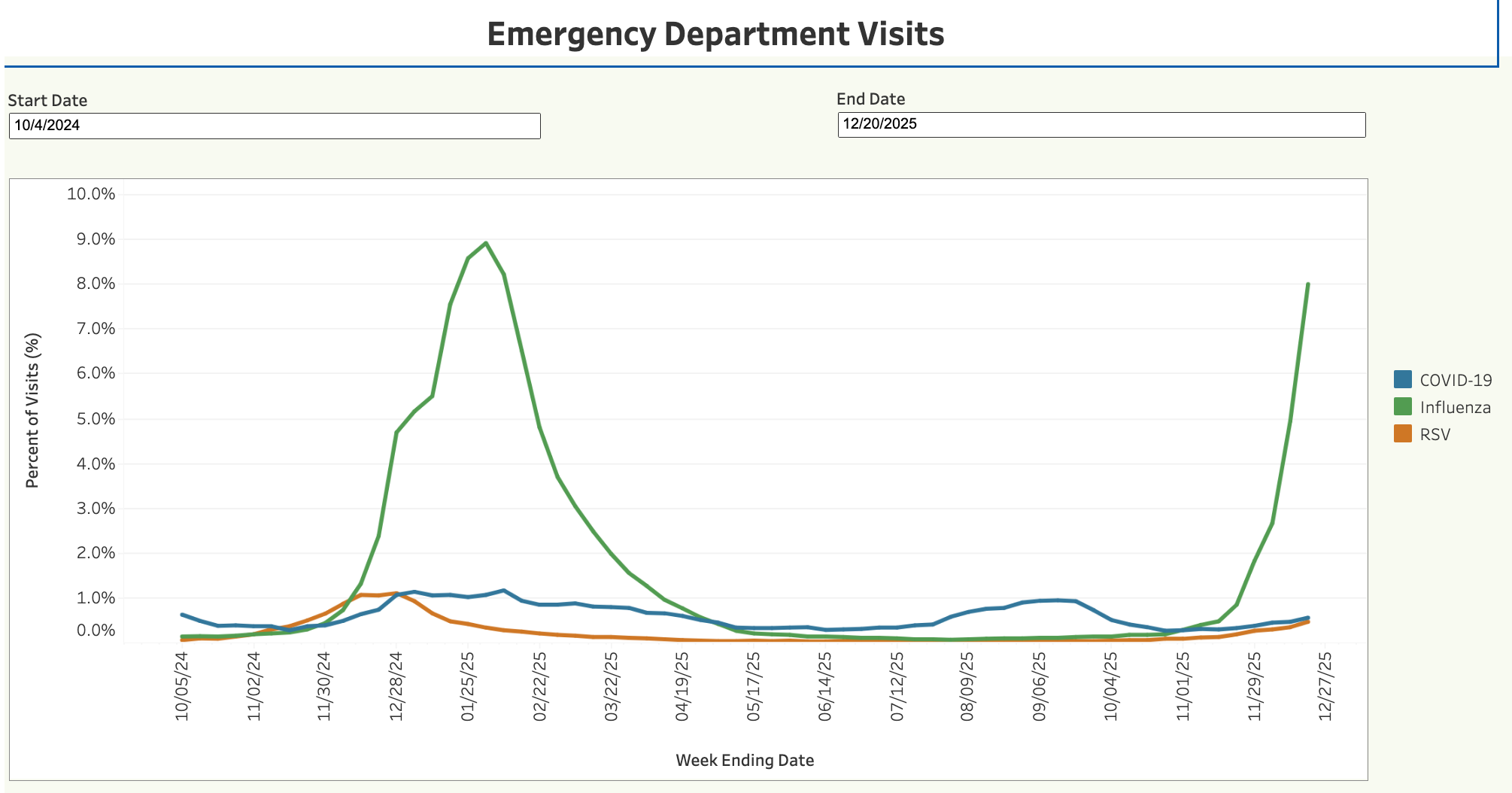
In New York, excluding New York City, nearly 14% of outpatient visits were for ILI, and roughly 7% of ED visits were for flu. Flu is also very high and rising in New York City, where 8.8% of ED visits and 4.9% of hospitalizations were for flu.
COVID-19
Covid-19 activity remains pretty low (thankfully, given what’s going on with flu!), but is increasing in several states.
In Kansas, ED visits have increased to 1%, which is where they peaked during the small end-of-summer wave, and just a bit shy of last winter’s peak (of 1.4%). Similarly, in Minnesota, Covid-19 is at 0.9% of all ED visits and hospitalizations, which is also where it peaked at the end of the summer/early fall.
In Alabama, Massachusetts, and Maryland, Covid-19 is low but ED visits have increased slightly for each of the past three weeks. Similarly, Covid-19 is low but increasing in Iowa. ED visits in the state have increased over the past month from a low of <0.5% to 1.1%, and test positivity has been creeping upward as well. New York is also seeing a rise in Covid-19, with the rate of ED visits doubling since the end of October, to 0.9%.
Despite these increases, Covid-19 remains stable in many states. In Alaska, Covid-19 is low and steady, with ~50-60 new reported cases each week for the past several weeks. Similarly, Covid-19 held low and steady in Arizona and Colorado, accounting for 0.4% and 0.6% of ED visits, respectively. And in Illinois, Covid-19 remains low at 1.1% of ED visits, and 1% of all hospitalizations. Rates also also low and stable in Hawaii, Nevada, Virginia, New Jersey, and New York City.
RSV & Other Bugs
RSV: RSV continues to slowly rise. In Alaska, RSV remains below average for this time of year. However, the number of confirmed RSV cases has been steadily rising over the past month, and was 75 this past week, up from 53 the week before. Similarly, in Arizona, RSV moved up to 132 confirmed cases, from 102 the week before. And in Iowa, RSV has bumped up a bit in the past couple weeks, from 0.1% of ED visits to 0.3% of ED visits, though this remains very low overall. In Minnesota, test positivity has been slowly increasing for the past two months, but remains about half of where it was this time last year. RSV remains low but rising in Massachusetts and New York.
In Alabama, RSV has been steadily climbing and is now at 0.7% of ED visits, which is above the Covid-19 rate in the state right now. Similarly, in New Jersey, visits to the ED for RSV are tied with Covid-19, at 0.5%, and test positivity is moderate and steady at 5%.
In Kansas, after several weeks of increasing ED visits for children under the age of 13, rates dipped slightly this past week to 0.9%. RSV has held steady at ~0.3-0.4% of ED visits for the past month in Hawaii, and rates remain similarly low and flat in Nevada, Virginia. In Colorado, ED visits remain extremely low at just 0.1%.
Other bugs:
Rhinoviruses/enteroviruses are still circulating widely. Test positivity is at 23% in Iowa, 12.1% in Illinois, and 10% in New York City.
Adenovirus, human metapneumovirus, and mycoplasma are all also causing respiratory infections right now.
Norovirus
Wastewater activity moderate and rising nationally. In the Midwest and Northeast, wastewater activity is high and rising. It is moderate and rising in the West, but moderate and falling in the South.
The best protection against noro is frequently washing your hands and high-touch surfaces with soap and water, and avoiding touching your face.
Food recalls
The following foods are being recalled because they are contaminated. Please check your cupboards and throw out any of these items:
New:
There is a big recall of hundreds of products — from Airhead candies to meat to Splenda packets — that passed through a single distributor and were sold to over 50 stores, primarily in Minnesota and Indiana. I strongly urge you to check out the list of affected stores (here) and if you’ve shopped at one of them recently, check out the much longer list of items that are being recalled (here)
Country Vet Biscuits & Heartland Harvest Dog Biscuits [for dogs] are being recalled for potential contamination with Salmonella. Salmonella can sicken both pets who consume the treats, and humans who handle the products (or who touch surfaces the items touched). (more info)
Forward Farms Grass-Fed Ground Beef (more info)
Previously Reported:
Frozen raw shrimp sold under the Market 32 and Waterfront Bistro brand names, due to possible cesium-137 contamination (more info)
Mild Cheddar Cheese under the Charlevoix Cheese Company label, sold in Michigan (more info)
Tamales, various flavors, in 4 count packs, sold by Primavera Nueva Inc. (more info)
Salted Caramel Cluster Non-Dairy Frozen Dessert sold under the So Delicious label (more info)
Town Food Service Equipment Co. Aluminum Saucepans, due to potential lead contamination (more info)
Lucky Foods cinnamon powder, due to potential lead contamination (more info)
ByHeart Infant Formula due to potential botulism contamination (more info)
In other news
South Carolina measles outbreak grows. 9 new cases were reported between December 19 and 23 in the state, bringing the total for the year to 156. Nearly 250 people are in quarantine following exposures, and 7 are in isolation. Out of the 156 cases, only 1 was known to be fully vaccinated (145 were unvaccinated, 3 were partially vaccinated, and 4 had unknown vaccination status). Nationwide, the number of reported measles cases was 2,012 as of December 23. This is by far the highest number of reported cases since the virus was declared eliminated in 2000.
Salmonella outbreak linked to raw oysters. At least 64 people in 22 states were infected between June 21 and November 28 of this year. Given that most people do not seek medical care for Salmonella infection, and many are not tested even if they do, the numbers of affected individuals is likely much larger. Most of the cases interviewed have reported eating raw oysters, and samples taken from patients appear to be the same strain. The CDC and FDA are still investigating the source of the outbreak and trying to trace it to specific sources of oysters.
Measles epidemic in Darfur. More than 1,300 cases of measles have been reported in the Darfur region of Sudan since September, according to Doctors Without Borders. The outbreak is occurring amid ongoing internal conflict and displacement of civilian populations. The fighting, which has involved deadly attacks on healthcare facilities, has significantly disrupted healthcare provision and led to plummeting vaccination rates. Measles vaccination coverage of children has dropped from 74% in 2019 to 36% this year, leaving millions of young children at high risk of severe illness.
Get detailed, state-specific public health updates with regional editions—available to paid subscribers. Stay informed where it matters most to you!

Outpatient ILI is the percentage of visits to the doctor that are for fever and cough or sore throat.
Thank you. Excellent report.
Thank you for this timely update! Shared on Facebook.